How to Talk to Your Doctor About Health Anxiety
Talking to your doctor about health anxiety can involve discussing two things at once: the physical symptoms or concerns that brought you to the appointment, and the worry, checking or reassurance-seeking that happens around them.
You do not need to decide beforehand whether what you are experiencing is “physical” or “anxiety”. Your role is to describe what you have noticed and how it is affecting you. Your GP can then decide what medical assessment or investigation is appropriate and help you discuss support for the anxiety itself.
This distinction matters because health anxiety can involve persistent worry about illness, repeated checking of the body, reassurance seeking, searching for health information, avoidance and worry that a doctor or test has missed something. These patterns can be important for your doctor to know about, but they do not by themselves establish a diagnosis.
Preparing for the conversation can help you give your doctor a clearer picture without turning the appointment into another attempt to achieve complete certainty.
Prepare Notes Before You Speak to Your Doctor
 \
\
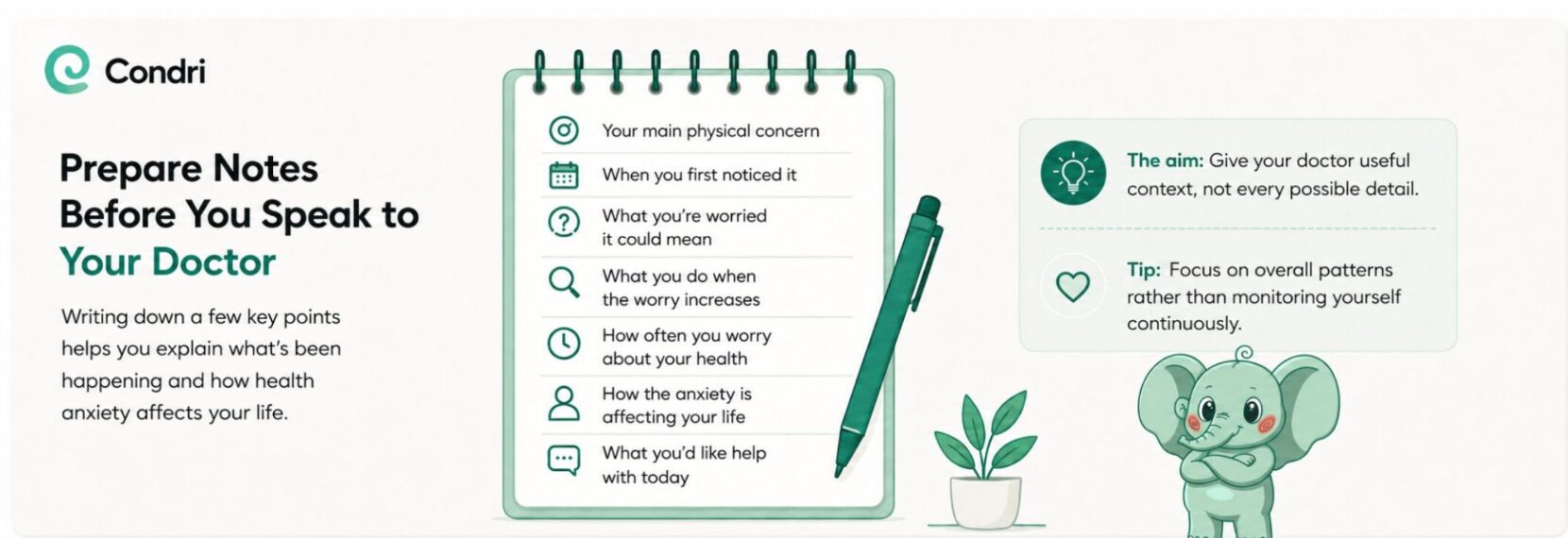
Writing down a few important points before your appointment can make it easier to explain what has been happening, particularly if anxiety makes it difficult to organise your thoughts.
Try to keep your notes focused. You do not need to create a detailed record of every bodily sensation you have noticed.
Instead, make a short note of:
- the main physical symptom or concern you want to discuss
- when you first noticed it
- any clear changes you think are relevant
- what you are worried it could mean
- how often you find yourself worrying about your health
- what you tend to do when the worry increases
- how the anxiety is affecting your everyday life
- what you would like help with during the appointment
The aim is to give your doctor useful context, rather than produce enough information to eliminate every possible uncertainty.
The NHS suggests tracking patterns such as body checking, reassurance seeking and looking for health information. If you choose to note these behaviours before your appointment, focus on the overall pattern rather than monitoring yourself continuously.
Before Your GP Appointment
You could screenshot or copy this short template:
What I’ve noticed:
[Your main physical concern]
When I first noticed it:
[Approximate timing]
What I’m worried it might mean:
[The health fear you are experiencing]
What I do when I become worried:
[For example, searching, checking or asking for reassurance]
How much time the worry takes up:
[An approximate description]
How it affects my life:
[Work, relationships, sleep, concentration or activities]
What I’d like help with today:
[Your main questions or concerns]
Keeping this brief can also help you identify the most important points if appointment time is limited.
Explain Your Physical Symptoms Clearly and Concisely
Tell your doctor what you have physically noticed without feeling that you must first work out whether anxiety is responsible.
Experiencing health anxiety does not mean a new or ongoing physical concern should automatically be attributed to anxiety. Equally, you do not have to prove that a symptom has a physical explanation before discussing it.
Try beginning with the main reason you booked the appointment.
For example:
“The main thing I wanted to discuss is [concern]. I first noticed it around [time], and this is what I’ve noticed since.”
Your doctor may ask questions about your symptoms, medical history, medicines or other relevant factors. Answer these as accurately as you can.
If anxiety has made you notice many different sensations, it can be tempting to describe every one immediately. Starting with your main concern can make the conversation easier to follow. You can then answer your doctor’s follow-up questions and mention other information where relevant.
Be Honest About Your Health-Related Fears
Telling your doctor what you are frightened a symptom could mean can provide useful context about the anxiety surrounding your health.
You might worry that mentioning health anxiety will make your doctor take physical concerns less seriously. Because of this, some people may focus entirely on the physical symptom and leave the anxiety itself unexplained.
You can discuss both.
For example:
“I’ve been worried about this symptom, but I’ve also noticed that I become extremely frightened about what symptoms could mean and find it difficult to stop thinking about them.”
It can also be useful to explain what happens after you receive reassurance.
You might notice that:
- reassurance helps for a short time before the worry returns
- you begin questioning whether something was missed
- you seek another opinion or another source of information
- one health worry settles, and another soon takes its place
- uncertainty about your health feels particularly difficult to tolerate
The NHS includes worrying that a doctor or medical test may have missed something among the possible features of health anxiety. Mentioning this fear does not mean you are telling your doctor how to interpret your physical symptoms. It helps explain the wider pattern you are experiencing.
Describe How Health Anxiety Affects Your Daily Life
Explaining the effect health worries have on your life can help your doctor understand the scale of the problem beyond one particular symptom.
Health anxiety can take up considerable mental space. The impact may be just as important to describe as the individual fear that prompted the appointment.
Tell your doctor if health worries are affecting areas such as:
- concentration
- work or study
- sleep
- relationships
- social activities
- exercise or other normal activities
- your ability to relax
- the amount of time you spend researching health
- activities or situations you avoid
- how frequently you seek medical or other reassurance
The NHS advises speaking to a GP if worries about your health are preventing you from leading a normal life or self-help is not working.
You do not need to wait until health anxiety has affected every part of your life before mentioning it. Describe what is happening for you as accurately as possible.
Talk About Your Checking and Reassurance-Seeking Habits
Your doctor may understand your health anxiety more clearly if you explain what you do when fear increases, not just what you think or feel.
Some behaviours may not initially seem relevant to a medical appointment.
For example, you might:
- Google symptoms repeatedly
- check parts of your body
- ask your partner, friends or relatives whether they think you are OK
- ask several people the same health-related question
- repeatedly reread test results
- revisit previous medical advice
- use forums or social media to research illness
- ask AI tools to interpret symptoms
- return for reassurance when previous reassurance has stopped feeling convincing
The NHS identifies repeated body checking, reassurance seeking and obsessive searching for health information among possible features of health anxiety. Its self-help guidance also suggests tracking these patterns.
That short-term relief can be important to explain.
A common pattern can look like this:
Health trigger → frightening interpretation → anxiety → checking or reassurance → temporary relief → renewed doubt → more checking or reassurance
This does not mean seeking medical advice is inherently a problem. Appropriate medical consultation and repetitive anxiety-driven reassurance seeking are not necessarily the same thing.
An article cannot decide which applies to a particular appointment. Your doctor is the appropriate person to assess your individual medical concerns.
What you can do is be open about the pattern.
For example:
“When I get worried, I search for information and ask people for reassurance. It settles me briefly, but then I start doubting the answer and feel that I need to check again.”
That gives your GP information about both the health concern and your response to uncertainty.
Explain What You Have Already Tried to Manage the Anxiety
Tell your doctor about anything you have already tried to help with your health worries and what happened when you tried it.
This could include:
- self-help resources
- Cognitive Behavioural Therapy (CBT)
- previous talking therapy
- relaxation or mindfulness techniques
- journalling
- digital mental health tools
- previous medication, where relevant
- trying to reduce checking or reassurance
- avoiding health-related triggers
There is no requirement to try particular self-help techniques before asking a GP for support.
If something helped temporarily but the anxiety returned, that is useful information too. Similarly, tell your doctor if you found an approach difficult to use or if previous support did not address health anxiety specifically.
CBT is a talking therapy in which a therapist helps you work on patterns in how you think and act. It is collaborative and usually involves agreed goals and practice between sessions.
For health anxiety, CBT may include work on patterns such as checking, reassurance seeking, avoidance and interpretations of health-related experiences rather than focusing only on the content of individual fears.
Ask How Your Doctor Decides Whether Tests Are Needed
If you are worried about whether investigations are needed, ask your doctor to explain their reasoning and what they think the appropriate next step should be.
You do not have to choose between demanding a test and saying nothing about your concern.
Useful questions might include:
- “Can you explain how you’re deciding whether any investigations are needed?”
- “What is the next step based on what I’ve told you?”
- “What should I do if the situation changes?”
- “When would you want me to come back?”
These questions focus on understanding the clinical plan.
For someone with health anxiety, uncertainty around testing can be particularly difficult. A test may feel as though it could provide the certainty needed to stop worrying. Yet health anxiety can also involve continuing to worry that a doctor or test has missed something. The NHS recognises this concern as a possible feature of health anxiety.
This does not mean you should avoid investigations recommended by a clinician. It also does not mean more testing or less testing is automatically the right approach.
Your GP should make decisions about assessment and investigation using your individual clinical circumstances. You can ask them to explain those decisions so you understand the plan.
Request Clear Explanations About Your Symptoms and Next Steps
If something your doctor says is unclear, ask them to explain it again in language you understand.
Understanding the plan is different from repeatedly seeking certainty.
You might ask:
- “Could you explain that in simpler terms?”
- “What happens next?”
- “Do I need to do anything at the moment?”
- “When should I follow up?”
- “Is there anything specific you want me to monitor?”
- “What changes would mean you want me to seek further medical advice?”
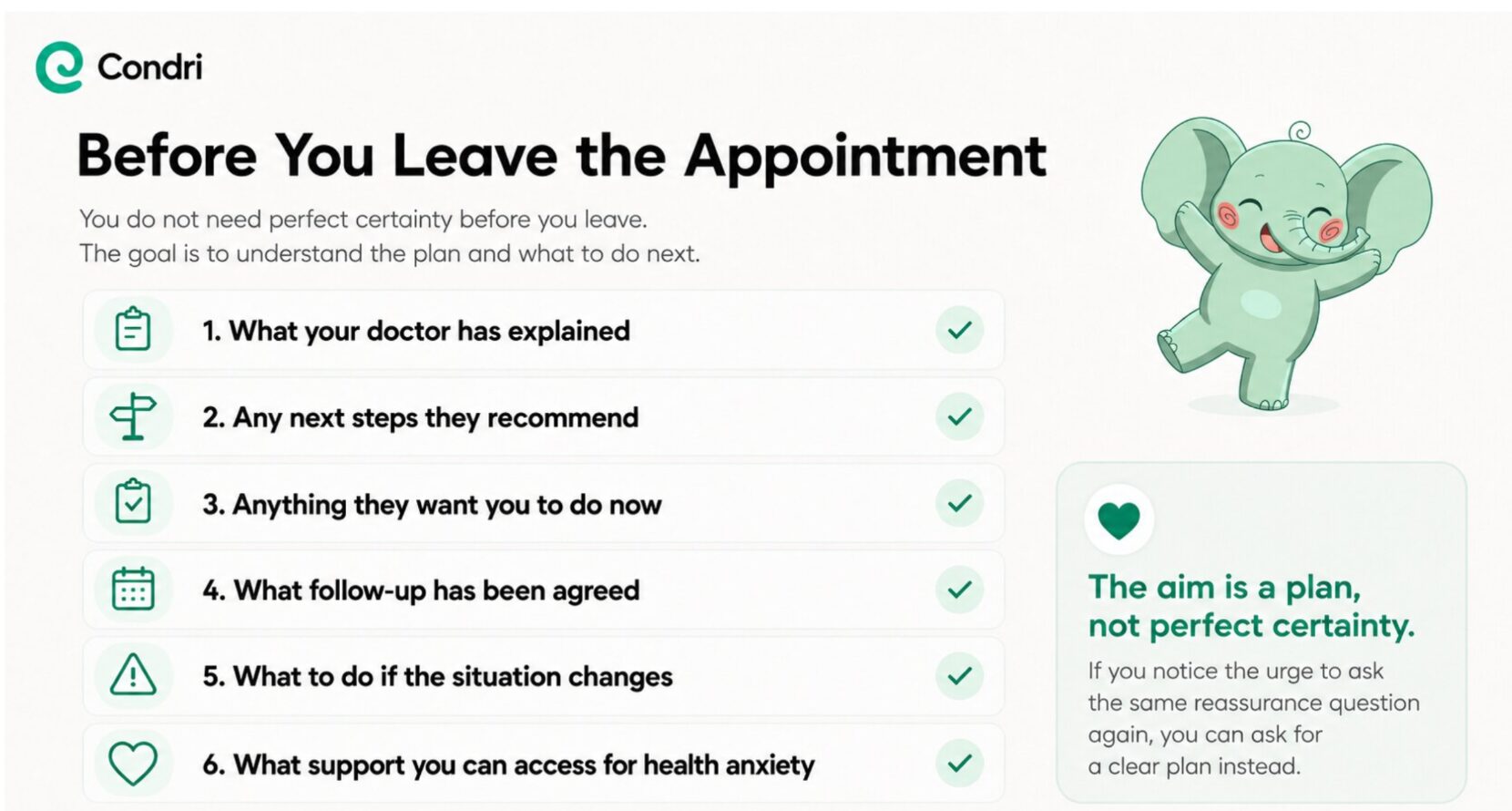
The goal is to leave knowing what has been decided, what you need to do and what follow-up has been agreed.
Repeatedly asking the same question in slightly different ways because the answer does not feel reassuring enough may be worth mentioning as part of your health anxiety.
If you recognise yourself doing this, you can say so.
For example:
“I notice that I keep wanting to ask the same question because I’m trying to feel completely certain. Could we agree what the plan should be from here?”
That shifts the conversation from obtaining another moment of reassurance towards having a shared plan.
Ask About Follow-Up Rather Than Trying to Resolve Every Future Possibility
Before the appointment ends, ask what your doctor recommends regarding follow-up.
Health anxiety can make unanswered “what if?” questions feel urgent. Trying to cover every future possibility during one appointment, however, may leave you with more information to analyse rather than a clearer understanding of what to do.
Instead, ask about the process.
For example:
“When should I follow up about this?”
or:
“If things change, what would you like me to do?”
This leaves the medical decision with your clinician while giving you practical guidance.
A follow-up plan may also help you notice the difference between acting on agreed medical advice and seeking additional reassurance because anxiety has risen again.
If you are unsure which of those is happening, you do not need to work it out perfectly by yourself. You can discuss that difficulty with your GP too.
Ask for Help With the Health Anxiety Itself
You can ask for support with health anxiety even if the appointment originally started with a physical concern.
You might say:
“I’d also like some help with how much I’m worrying about my health. What support is available?”
Your GP may discuss appropriate options based on your circumstances. In England, this may include NHS Talking Therapies, which eligible adults can often access by self-referral without first seeing a GP. The NHS lists CBT among the talking therapies that may be used for health anxiety.
You can also tell your doctor what you would particularly like help changing.
For example:
“I’d like help reducing how often I check and seek reassurance because I feel caught in a cycle.”
This can make the conversation more specific than simply saying you feel anxious.
What If You’re Worried Your Doctor Will Dismiss Your Symptoms?
If you are afraid that mentioning health anxiety will cause your physical concerns to be dismissed, say so directly.
For example:
“I’m aware that health anxiety is affecting me, but I’m worried that talking about the anxiety will mean my physical concerns aren’t taken seriously. I’d like to discuss both.”
This communicates the problem clearly without asking your doctor for absolute reassurance.
Health anxiety and physical health concerns do not have to be treated as mutually exclusive topics. You can describe your physical experiences, allow your doctor to make appropriate clinical decisions and also discuss the psychological pattern developing around those experiences.
You also do not need to convince your GP that you definitely have health anxiety before asking for help. Explain what you notice happening. The behaviours, fears and impact on your life give your doctor useful information.
Before You Leave the Appointment
A useful appointment does not have to end with complete certainty about your health. Instead, try to leave knowing what your doctor has advised and what the next step is.
Before you finish, check that you understand:
- what your doctor has explained
- whether they have recommended any next steps
- whether there is anything they want you to do
- what follow-up has been agreed
- what to do if the situation changes
- what support you can access for health anxiety
If you notice yourself wanting to ask the same reassurance question again, consider whether there is a different question underneath it.
Perhaps you do not understand the plan.
Perhaps you are unsure when to return.
Perhaps you want help managing the urge to seek certainty.
Those are all things you can discuss openly.
The Aim Is a Plan, Not Perfect Certainty
Talking to your doctor about health anxiety does not mean choosing between physical healthcare and psychological support.
You can talk about the symptom or concern that brought you to the appointment while also explaining the fear, checking, Googling and reassurance-seeking that happens around it.
The most useful conversation is often one that gives your doctor the full picture.
Describe what you have noticed. Explain what you fear. Be open about what you do when the anxiety rises. Ask your doctor to explain their reasoning, appropriate next steps and follow-up plan. Then ask what support is available for the health anxiety itself.
If you are beginning to question whether health worries are having a bigger impact on your life, Condri’s health anxiety quiz can help you reflect on the patterns you are experiencing and consider a suitable next step.
Common questions
- Should I Tell My Doctor I Think I Have Health Anxiety?
- Yes, you can tell your doctor that you are concerned about health anxiety without having diagnosed yourself. Explain the patterns you have noticed, such as persistent health worries, checking, reassurance seeking or repeated searching for health information. Your doctor can consider this alongside any physical concerns you have.
- Can I Talk About Physical Symptoms and Health Anxiety in the Same Appointment?
- Yes. You do not need to decide whether a physical experience is caused by anxiety before discussing it. Describe the physical concern clearly and also explain how anxiety around your health is affecting you. Your doctor can decide what medical assessment is appropriate and discuss support for the anxiety.
- What Should I Tell My Doctor About Health Anxiety?
- It can help to explain what you are afraid of, how frequently you worry, what you do when the anxiety increases and how much the problem affects everyday life. Mention behaviours such as checking, Googling symptoms or repeatedly asking for reassurance if they are part of your experience.
- What If I Think I Need a Medical Test?
- Tell your doctor about your concern and ask them to explain how they are deciding whether an investigation is clinically appropriate. You can also ask what the next step is, when they would want you to follow up and what you should do if the situation changes. An article cannot determine whether an individual medical test is appropriate.
- Can a GP Help With Health Anxiety?
- A GP can discuss the difficulties you are experiencing and the support that may be appropriate for you. The NHS lists CBT among the talking-therapy options that may be used for health anxiety. In England, eligible adults can also self-refer to NHS Talking Therapies.