The Complete Guide to ERP for Health Anxiety
Exposure and Response Prevention (ERP) is a behavioural approach used within Cognitive Behavioural Therapy (CBT). It involves approaching thoughts, sensations, situations or uncertainty that trigger anxiety while reducing the checking, reassurance seeking, avoidance or other safety behaviours that are used to obtain relief or certainty.
ERP is not simply about making yourself anxious or forcing yourself to confront frightening health information. It is about learning to respond differently when uncertainty about your health appears.
Someone might notice a sensation and think, “What if this is serious?” They may then search online, inspect their body, compare symptoms or ask somebody else for reassurance. ERP creates an opportunity to practise a different response rather than automatically entering that familiar cycle.
Exposure-based approaches have been studied as part of psychological treatment for health anxiety, with encouraging results. A 2026 systematic review and network meta-analysis of 35 randomised clinical trials involving 3,263 participants found significant benefits for several psychological interventions, including CBT and exposure therapy, compared with a waiting-list control. In its component analysis, exposure and response prevention (ERP), cognitive restructuring and mindfulness were among the treatment components associated with better outcomes. The authors concluded that CBT and third-wave CBT are reasonable first-line psychological approaches for health anxiety.
The wider evidence for CBT is also encouraging. A 2019 systematic review and meta-analysis found a moderate-to-large overall effect of CBT for health anxiety. Across the included studies, the pooled response rate was 66% and the pooled remission rate was 48%. These figures describe CBT as a treatment approach, not ERP specifically, and individual outcomes vary.
Earlier research has also found benefits from CBT for health anxiety, including exposure-based CBT delivered through therapist-guided internet treatment, unguided internet treatment and bibliotherapy. In one randomised controlled trial involving 132 people with somatic symptom disorder or illness anxiety disorder, all three active treatment formats produced large improvements compared with a waiting-list control.
These findings support CBT, including ERP as one potentially important component, as an evidence-based psychological approach for health anxiety. They do not mean that ERP works for everyone, nor that every exposure exercise is suitable for self-directed practice.
They also do not mean ignoring physical symptoms or avoiding appropriate healthcare. A psychological approach to health anxiety should never be used to decide that a physical symptom is “just anxiety”. Appropriate medical assessment remains important when it is needed.
This guide explains how ERP for health anxiety works, the behaviours it can target, how an exposure hierarchy can be structured, common difficulties and how to measure progress without making “How anxious do I feel?” your only measure of success.
What is Exposure and Response Prevention for Health Anxiety?
ERP combines two processes: encountering an anxiety-provoking trigger, known as exposure, and reducing the usual safety behaviour that follows, known as response prevention.
Exposure: Encountering a thought, situation or source of uncertainty connected with a health fear.
Response Prevention: Reducing the repetitive behaviour normally used to obtain certainty or relief.
Exposure might involve approaching something you usually avoid. Response prevention might involve not immediately Googling, checking or asking for reassurance. Exposure creates an opportunity for new learning; response prevention helps prevent the old safety behaviour from dominating your response. Neither involves deliberately putting yourself in danger or avoiding appropriate healthcare.
Imagine you notice a bodily sensation.
Your mind responds: “What if this means something serious?”
Your usual response might be to search the sensation online repeatedly until you find an explanation that temporarily feels reassuring.
An ERP-based response could involve allowing the uncertainty to be present without immediately starting that repetitive search.
Notice what ERP does not require you to conclude. You do not have to tell yourself: “This sensation definitely means nothing.”
The aim is not to replace frightening uncertainty with reassuring certainty. It is to practise responding differently when certainty is unavailable.
Exposure without response prevention can miss an important part of the process. For example, somebody could deliberately read a health-related article as an exposure but spend the next hour checking their body and asking other people whether they seem well. They encountered the trigger, but the exposure became another opportunity to practise the same safety behaviours.
That is why both halves of ERP matter: exposure and response prevention.
How the Health Anxiety Cycle Keeps Fears Going
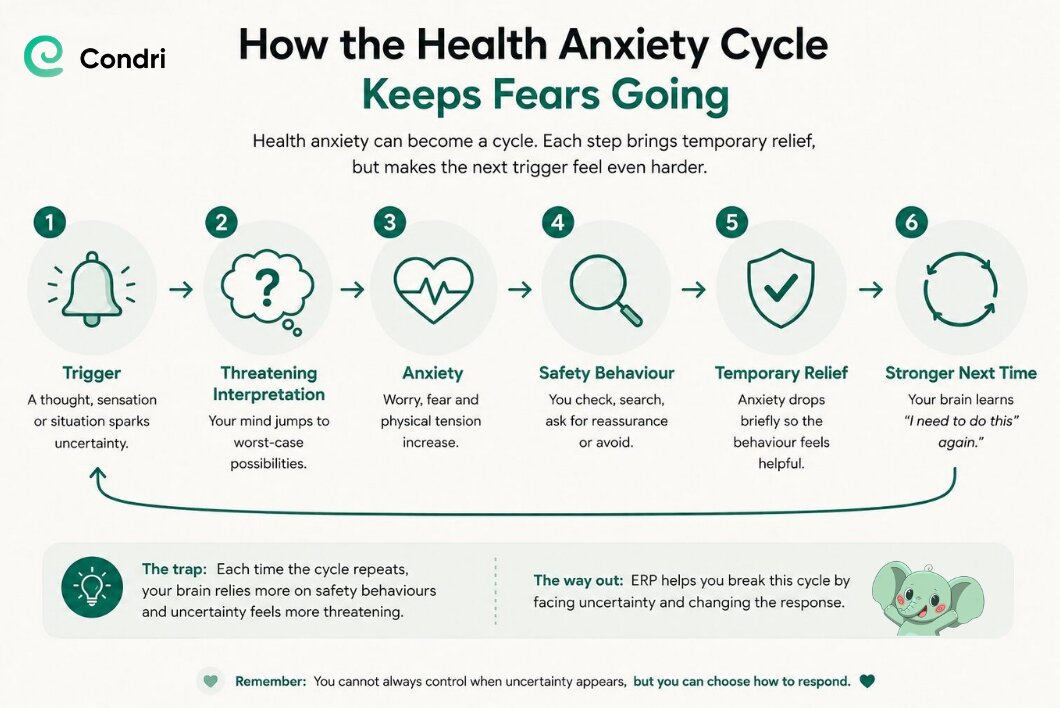
Health anxiety can become self-reinforcing when a trigger leads to a threatening interpretation, anxiety and behaviours that bring temporary relief but strengthen the urge to seek certainty again.
A simplified version of the cycle looks like this:
Trigger → threatening interpretation → anxiety → safety behaviour → temporary relief → increased reliance on the safety behaviour next time
Understanding this cycle helps explain why the response after a frightening thought can be as important as the thought itself.
Body Sensations and Health Anxiety Triggers
Health-anxiety triggers can come from inside or outside your body. An internal trigger might be noticing a sensation, change or physical feature.
External triggers can include:
• Hearing about somebody else’s illness
• Seeing a health story online
• Attending a medical appointment
• Watching a medical programme
• Having a health-related conversation
• Seeing somebody discuss symptoms on social media
• Receiving routine health information
The trigger itself does not have to be dramatic. What matters is how you respond to it.
Threatening Thoughts and Worst-Case Interpretations
Ambiguous information can become especially difficult when your attention is focused on possible health threats.
A sensation may quickly lead to a thought such as: “What if this is the first sign of something serious?”
An upcoming appointment might trigger: “What if they find something?”
A health story might produce: “What if I have that too?”
ERP does not require you to prove these thoughts irrational. Health and illness inevitably involve some uncertainty, which is precisely why trying to achieve complete certainty can become such a powerful trap. The goal is not to establish that the feared outcome is impossible. It is to develop greater flexibility in how you respond when the possibility feels frightening.
Safety Behaviours and Temporary Relief
A safety behaviour is something you do to prevent a feared outcome, check whether it is happening or reduce uncertainty about it.
In health anxiety, this can include:
• Searching symptoms online
• Inspecting or touching part of your body repeatedly
• Measuring your heart rate or other bodily information unnecessarily
• Comparing one side of your body with the other
• Asking a partner, friend or family member for reassurance
• Posting symptoms in an online community
• Repeatedly reviewing test results
• Seeking repeated consultations primarily to obtain reassurance
• Avoiding activities associated with feared sensations
• Mentally replaying something a healthcare professional said
The difficulty is that these behaviours can feel helpful in the short term. Finding a reassuring explanation, for example, might briefly lower anxiety.
But the brain can also learn something else from that sequence: “When uncertainty appears, I need to check.”
The next trigger can therefore produce an even stronger urge to repeat the behaviour.
It is important to distinguish this from appropriate healthcare behaviour. Attending a medical appointment, following a clinician’s advice, monitoring a known condition as instructed or seeking assessment for a concerning symptom are not automatically safety behaviours.
The important question is often the function and pattern of the behaviour.
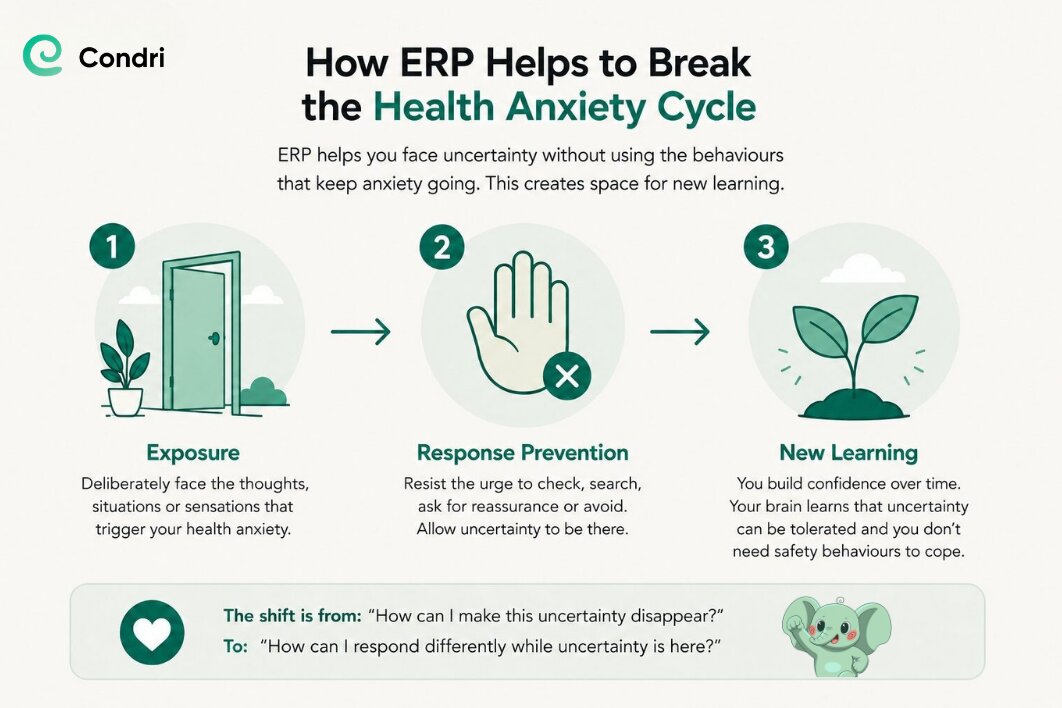
How ERP Helps to Break the Health Anxiety Cycle
ERP interrupts the cycle by helping you encounter uncertainty without automatically using the behaviour you normally rely on to reduce anxiety or obtain reassurance.
The central shift is from:
“How can I make this uncertainty disappear?”
to:
“How can I respond differently while uncertainty is here?”
That does not mean refusing sensible action. It means learning to distinguish between action that serves a practical purpose and repetitive behaviour whose main function is to obtain certainty or relief.
Exposure to Health-Related Uncertainty
Exposure does not mean trying to convince yourself that a feared event will happen.
It means deliberately making room for situations, thoughts or uncertainty that you have been trying to control or avoid.
For one person, that might mean continuing an appropriate everyday activity despite the possibility of noticing sensations that normally trigger checking.
For another, it might mean encountering a health-related word without immediately searching for symptoms.
The precise exposure depends on the person’s pattern of anxiety and should not involve genuine danger.
The purpose is not to prove that you are safe- it is to practise responding differently to uncertainty.
Preventing Reassurance and Other Safety Behaviours
Response prevention targets what usually happens next.
If your pattern is:
Trigger → Google → temporary relief
the behaviour being targeted may be repetitive searching.
If it is:
Trigger → ask partner → temporary relief
the target may be reassurance seeking.
If it is:
Trigger → mentally replay doctor’s explanation → temporary relief
the target is less visible, but it can still function as a safety behaviour.
Response prevention can therefore involve outward behaviours and mental behaviours.
Learning Without Making Calmness the Goal
One common misunderstanding is that a successful exposure ends when anxiety falls.
Anxiety may decrease during some exposures. At other times, it may remain uncomfortable.
If you judge every exercise by whether you feel calm afterwards, ERP itself can become another attempt to control anxiety.
A more useful question is:
“Did I practise the response I intended to practise?”
The learning goal might be discovering that you can notice an urge to check without automatically obeying it, or that you can continue with your day while an unanswered health-related thought remains in your mind.
That is different from proving the feared outcome cannot happen.
Which Health Anxiety Behaviours Can ERP Target?
ERP can target many repetitive behaviours used to obtain certainty about health, including obvious habits such as Googling symptoms and subtler behaviours such as mentally reviewing medical advice.
Googling Symptoms and Researching Illnesses
Looking up health information is not automatically a safety behaviour.
The relevant question is often the function and pattern of the search.
Are you looking for information for a practical reason, or have you searched the same concern repeatedly because no answer feels certain enough?
An anxiety-driven search can easily expand. One search leads to another condition, another forum, another comparison and another attempt to find the one piece of information that finally settles the fear.
ERP may target this repetitive search-and-reassure loop.
Checking and Scanning Your Body
Body checking can include touching, inspecting, measuring, comparing or repeatedly monitoring a particular sensation.
The checking may be obvious, such as repeatedly looking at an area in a mirror. It can also be subtle, such as repeatedly directing your attention towards a body part to see whether a sensation is still present.
Response prevention is not a blanket rule to never examine your body.
Appropriate self-care, screening and medically advised monitoring are separate issues.
The target is repetitive checking driven primarily by the need to repeatedly settle anxiety.
Seeking Reassurance From Other People
Reassurance can come from partners, family members, friends, online communities or professionals.
Questions may include:
“Does this look normal?”
“Do you think I should be worried?”
“Would you be concerned if this happened to you?”
The answer may feel helpful for a while. Then doubt finds a new question.
ERP can involve learning to notice the urge for reassurance without automatically turning another person into a certainty-checking system.
Repeatedly Contacting Healthcare Professionals
Healthcare professionals are an essential source of appropriate assessment and advice. ERP should never be used as a reason to avoid medical care when it is needed.
At the same time, some people with health anxiety recognise a separate pattern in which they repeatedly seek consultations or additional opinions primarily because reassurance from the previous consultation has stopped feeling certain enough.
This is an area where professional psychological support can be particularly valuable. The goal is not to teach yourself which symptoms “count” as anxiety. It is to identify repetitive reassurance patterns without interfering with appropriate medical care.
Avoiding Health Information, Places or Activities
Health anxiety is not always about doing too much.
Sometimes it involves avoidance.
Someone may avoid medical programmes, conversations about illness or appropriate everyday activities because these situations trigger uncertainty.
Avoidance can reduce anxiety in the moment while making the avoided situation feel increasingly difficult to encounter.
Planned exposure may therefore involve gradually approaching appropriate situations that have been avoided.
Mentally Reviewing Symptoms and Medical Advice
Not every safety behaviour can be seen.
You might repeatedly:
• Replay what a doctor said
• Compare today’s sensation with yesterday’s
• Review a conversation for reassuring phrases
• Analyse whether a symptom has changed
• Mentally reconstruct a previous test result
• Try to remember whether somebody said a particular outcome was “unlikely” or “impossible”
These mental behaviours can perform the same function as searching online. They are attempts to settle uncertainty.
This is one reason ERP can be more complicated than simply “stop Googling”.
What Are the Different Types of ERP Exposure?
ERP can use several forms of exposure. The appropriate type depends on the fear being addressed and the individual’s circumstances.
In VIvo Exposure
In vivo means real-life exposure.
For health anxiety, this might involve gradually returning to an appropriate situation you have been avoiding because it triggers health-related uncertainty.
It could also involve encountering everyday health information without carrying out the usual reassurance routine afterwards.
The aim is purposeful contact with a relevant trigger, not putting yourself in genuine danger.
Imaginal Exposure
Imaginal exposure involves deliberately bringing a feared thought, image or uncertain scenario to mind rather than avoiding it or immediately neutralising it.
This can be useful when the feared scenario cannot or should not be recreated in real life.
The purpose is not to write yourself a reassuring ending. Nor is it to convince yourself that the feared outcome will occur.
The exposure is to the uncertainty and emotional material itself.
Because imaginal work can be intense and can sometimes become rumination, professional guidance may be useful.
Interoceptive Exposure
Interoceptive exposure involves planned exposure to bodily sensations that have become associated with fear.
This requires particular care in the context of health anxiety.
Some psychological treatments deliberately produce temporary bodily sensations as part of exposure. Such exercises are not suitable for everyone, particularly where medical conditions, physical limitations or uncertainty about suitability are present.
For that reason, this guide does not provide DIY interoceptive exercises. If interoceptive exposure appears relevant to your health anxiety, a suitably qualified professional can help determine whether it is appropriate and how it should be planned.
How to Create an ERP Hierarchy for Health Anxiety
An ERP hierarchy organises potential exposures from more manageable to more challenging while identifying the safety behaviour you are trying to change.
A hierarchy is not a competition to find the scariest possible task.
Its purpose is to create structure and support gradual learning.
IDENTIFY YOUR TRIGGERS AND SAFETY BEHAVIOURS
Start by mapping the pattern:
Trigger → thought → feeling → safety behaviour
For example:
Trigger: Read a general health story.
Thought: “What if I have this?”
Feeling: Anxiety and uncertainty.
Safety behaviour: Search the condition and compare its symptoms with your body.
This makes the behavioural target clearer.
Rank Exposures From Manageable to More Challenging
A simple zero-to-ten difficulty rating can help organise possible exposures.
This is subjective. A task rated four by one person might be an eight for somebody else.
The number is not a clinical score and does not tell you whether an exposure is appropriate. It simply helps organise your hierarchy.
Choose a Suitable Starting Point
Starting with the most difficult fear is not automatically better.
A manageable starting point can give you space to learn the mechanics of exposure and response prevention without becoming so overwhelmed that you cannot practise the intended response.
Illustrative examples:
• Seeing a general health headline → immediately search the condition → continue with the activity without opening a symptom search → 3/10 → practise leaving a question unanswered.
• Noticing the urge to ask a partner for reassurance → ask repeatedly what they think → notice the urge without immediately asking → 4/10 → separate anxiety from automatic reassurance.
• Passing an avoided health-related programme while browsing TV → immediately switch away → allow the programme title or description to remain visible without researching it → 5/10 → practise approaching rather than automatically avoiding.
• Receiving routine health information → re-read repeatedly for certainty → read it as practically required without repeated reassurance-driven review → 6/10 → reduce repetitive checking.
These are examples, not a personalised treatment plan. A suitable hierarchy depends on your circumstances and should not override medical advice.
Examples of ERP Exercises for Health Anxiety
The following examples illustrate ERP principles rather than provide personalised treatment instructions. They should not be used to avoid appropriate medical assessment or medically recommended monitoring.
Delaying the Urge to Search for Symptoms
Suppose your automatic response to uncertainty is to open a search engine.
An ERP exercise might focus on creating space between the urge and the behaviour rather than demanding that you never look up health information again.
The learning goal is:
“I can experience the urge to search without treating it as an instruction I must follow immediately.”
Be careful not to replace Google with another reassurance source.
Searching an AI chatbot, repeatedly checking a medical website or asking somebody else the same question can preserve the original loop in a different form.
Reducing Body Checking
If body checking has become repetitive, an ERP plan may target the repeated checks rather than appropriate medical or self-care behaviour.
For example, somebody might notice how often they return to the mirror, compare an area or monitor a sensation and work on reducing the anxiety-driven repetition.
The aim is not to create a universal rule that you must never examine your body. That could interfere with appropriate healthcare.
Responding Differently to Reassurance Seeking
Imagine you want to ask your partner:
“Are you sure you don’t think this is something serious?”
Before asking, you could identify what you are hoping the answer will achieve.
If you are seeking certainty that you have already asked for repeatedly, the ERP target might be allowing the question to remain unasked.
The difficult part is that you may still want reassurance.
Response prevention is not about making the urge disappear before you continue. It is about changing your response to the urge.
Approaching Avoided Situations
If anxiety has led you to withdraw from otherwise appropriate activities, exposure may involve a gradual return.
The learning target is not:
“This activity proves I am healthy.”
It is closer to:
“I can take part in an appropriate activity without making complete certainty about my health a prerequisite.”
Where there is any question about whether an activity is medically appropriate for you, follow relevant professional medical advice rather than using an exposure plan to make that decision yourself.
Allowing Uncertain Thoughts to Remain Unanswered
This can be one of the hardest parts of ERP for health anxiety.
A frightening thought appears:
“What if?”
Your mind may immediately start constructing an answer.
Maybe you search.
Maybe you review evidence.
Maybe you remember what a doctor said.
Maybe you ask an AI system to estimate the likelihood.
Sometimes the ERP practice is not providing another answer.
The thought can remain:
“What if?”
The response can be:
“I notice that I want certainty right now, and I am going to continue with what I was doing.”
That is not the same as deciding the feared outcome is impossible. It is practising life without solving every uncertain thought.
How to Practice ERP Safely and Effectively
Useful ERP practice has a clear behavioural purpose.
The aim should be learning and changing responses, not forcing anxiety to disappear.
Set a Clear Goal for Each Exercise
Compare these goals:
“I need to do this until I stop feeling anxious.”
and:
“I want to practise noticing the urge to seek reassurance without immediately acting on it.”
The second gives you a behaviour you can actually observe.
It also means an exercise can still be useful even if anxiety is present at the end.
Watch for Subtle Safety Behaviours
A safety behaviour can change shape.
You stop Googling but start asking an AI chatbot.
You stop checking the mirror but ask your partner to look instead.
You stop asking your partner but spend 20 minutes mentally reviewing what a doctor said.
You complete an exposure and then search: “How do I know ERP is working?”
This does not mean you have failed. It means you have identified another part of the cycle to work on.
Repeat Exposures Consistently
Exposure is generally a learning process rather than a one-off test of courage.
Repeated practice provides further opportunities to respond differently.
There is no universal schedule in this article because the appropriate frequency and intensity depend on the person, the exposure and how treatment is being delivered.
Record What You Learn
A short reflection can help you focus on behaviour rather than reassurance.
After an exercise, consider:
• What did I predict or fear?
• What did I feel?
• What safety behaviour did I want to use?
• Which response did I practise instead?
• Did another safety behaviour appear?
• What did I learn about my ability to tolerate uncertainty?
Avoid turning the record into a hunt for proof that you are safe.
The useful information is often about how you responded.
What ERP for Health Anxiety is Not
ERP is:
• Practising a different response to anxiety and uncertainty
• Reducing repetitive safety behaviours
• Purposeful, planned exposure
• Learning to tolerate unanswered questions
• Often structured gradually
• Compatible with appropriate healthcare
• A psychological approach with an evidence base
• A skill that can take practice
ERP isn’t:
• Proving that you definitely are not ill
• Never visiting a doctor
• Deliberately putting yourself in genuine danger
• Suppressing frightening thoughts
• Forcing yourself into your biggest fear immediately
• Ignoring medical advice
• A guarantee that anxiety will disappear
• A test of willpower
The medical boundary deserves emphasis.
ERP should not be used to decide whether a new or concerning physical symptom requires assessment. It does not teach you to diagnose yourself or determine from a sensation alone whether something is “just anxiety”.
Appropriate medical care and work on repetitive health-anxiety behaviours can coexist.
Common Challenges When Starting ERP
ERP can look simple on paper: face the trigger and reduce the safety behaviour. In practice, health anxiety can make both parts more complicated.
Waiting for Anxiety to Disappear
If you decide an exposure only “counts” when your anxiety reaches zero, you can accidentally turn calmness into a safety signal.
Progress can instead be measured by what you did while anxious.
Did you continue your planned activity?
Did you leave a question unanswered?
Did you notice an urge without automatically checking?
Those outcomes matter even when the emotional experience was uncomfortable.
Replacing one Safety Behaviour With Another
Safety behaviours are adaptable.
A person who stops using search engines might start repeatedly asking an AI chatbot to interpret symptoms.
Someone reducing body checking might ask their partner to check for them.
Someone who stops seeking reassurance aloud may perform the same process mentally.
When this happens, look at the function of the new behaviour.
If its purpose is still: “I need certainty before I can move on,” the reassurance cycle may have changed form rather than disappeared.
Turning ERP Into Another Form of Reassurance
ERP itself can become part of the cycle.
You might repeatedly ask:
“Did I do that exposure correctly?”
“Should I feel less anxious by now?”
“Does being anxious mean ERP is working?”
“How many exposures until I know I am getting better?”
Wanting guidance is reasonable, particularly when learning a psychological technique. The problem arises when repeated questions become another attempt to achieve certainty.
The distinction can be subtle, which is one reason professional guidance can help.
Starting With Exposures That Feel Too Difficult
A highly distressing exposure is not automatically a more effective exposure.
If an exercise is so difficult that you abandon it, become overwhelmed or rely heavily on safety behaviours to complete it, the plan may need adjusting.
A hierarchy provides a way to build practice progressively.
Feeling Discouraged by Setbacks
Health anxiety does not always improve in a straight line.
A stressful period, health story, appointment or genuine medical issue may increase worry or bring old behaviours back into focus.
Rather than treating this as proof that previous work has disappeared, it can be useful to identify the behaviour that has returned and revisit the strategies you have practised.
How Long Does ERP for Health Anxiety Take to Work?
There is no single timeline for ERP because progress depends on factors including the pattern and severity of health anxiety, the behaviours being targeted, how treatment is delivered and individual circumstances.
Research on psychological treatments can tell us whether interventions have produced benefits across groups of participants. It cannot tell an individual reader exactly how many days or exercises their own progress should take.
It is also useful to distinguish between an individual exposure and an overall course of psychological treatment.
One exposure is an opportunity to practise a different response. It is not a test that tells you whether ERP has “worked”.
Over time, progress may show up as changes in checking, reassurance seeking and avoidance even when health-related thoughts still occur.
This is another reason not to use immediate anxiety reduction as your only measure.
How to Measure Progress During ERP
Progress is often easier to understand when you measure what health anxiety is getting you to do, rather than only asking how anxious you feel.
Possible measures include:
• Body checking — how often repetitive checks occur
• Online searching — time spent in anxiety-driven symptom searches
• Reassurance seeking — how frequently you ask repeated certainty-seeking questions
• Mental checking — how often you catch yourself replaying or comparing information
• Avoidance — activities you can take part in despite uncertainty
• Response flexibility — whether you can notice an urge without automatically acting on it
• Daily life — whether you can return attention to work, relationships or other valued activities
A simple progress record might ask:
Trigger: What happened?
Urge: What did health anxiety want me to do?
Response: What did I actually do?
Learning: What did I learn about responding to uncertainty?
This shifts the focus from:
“Was I anxious today?”
to:
“How did I respond when anxiety appeared?”
Can You Practise ERP For Health Anxiety By Yourself?
Some people use self-help or guided digital resources to practise principles associated with ERP, but self-directed ERP is not appropriate for every person or situation. Professional guidance can help ensure exercises are suitable and correctly targeted.
Health anxiety can involve complicated overlaps between appropriate healthcare behaviour, reassurance seeking, avoidance and covert mental rituals.
It can therefore be difficult to identify the right target independently.
Professional input may be particularly useful when:
• You are unsure whether an exercise is appropriate.
• Anxiety is severe or significantly affecting daily life.
• You have several safety behaviours that keep changing.
• Exercises are becoming increasingly distressing.
• You are struggling to distinguish the purpose of a behaviour.
• Interoceptive exposure is being considered.
• Physical health considerations affect what is appropriate.
• Other mental health difficulties are also present.
Self-help should not involve creating risky exposures or overriding professional medical advice.
When to Seek Support From a Qualified Therapist
Consider professional support when health anxiety is substantially affecting your daily life, self-directed strategies are not helping, or you are finding ERP difficult to plan or manage.
In England, the NHS advises speaking to a GP when health worries are preventing you from leading a normal life or self-help is not working. Eligible adults can also self-refer to NHS Talking Therapies without first seeing a GP.
A qualified therapist can help identify safety behaviours, plan suitable behavioural experiments or exposures and notice covert reassurance strategies that can be difficult to spot alone.
You may particularly benefit from support if:
• Your distress feels severe or unmanageable.
• Health anxiety is affecting work, relationships or everyday activities.
• You are unsure how to create safe, appropriate exposures.
• Your safety behaviours keep changing.
• You have co-occurring mental health concerns.
• You are unsure how ERP fits alongside genuine medical needs.
• Self-directed attempts are making distress harder to manage.
If you need medical assessment for a physical health concern, seek appropriate healthcare. ERP is not a substitute for medical diagnosis.
How Condri Can Support Your Health Anxiety Practice
Condri is designed to support people experiencing health anxiety with psychological education and CBT-informed tools.
The app may provide tools that help people recognise health-anxiety patterns and practise responding differently when urges to check, search or seek reassurance arise. The purpose of these tools is not to provide medical reassurance or diagnose symptoms.
Condri does not replace appropriate medical care or individual psychological treatment where this is needed. Take the Condri Health Anxiety Quiz to get a clearer picture of your current health-anxiety experiences.
The quiz is a self-assessment tool, not a medical diagnosis. If you use a questionnaire to track change, try to treat the result as information for reflection rather than something you need to repeatedly check for reassurance.
How to Maintain Progress and Respond to Future Setbacks
Maintaining progress does not require never having another health-related worry.
Health uncertainty is part of life, and future triggers may bring familiar urges back.
The useful skill is recognising the pattern earlier. You might notice that symptom searches are becoming longer again.
Perhaps you have started asking your partner the same health question in several different ways.
Maybe a new form of checking has appeared.
Or perhaps you are avoiding activities you had previously returned to.
When that happens, revisit the basic sequence:
What triggered me?
What am I predicting?
What am I doing to try to obtain certainty?
Is that response helping me live according to my goals, or pulling me back into the checking and reassurance cycle?
ERP for health anxiety is ultimately less about eliminating every frightening thought and more about changing the relationship between uncertainty and action.
You may not get to choose when a health-related thought appears. You can practise having more choice about what happens next.
REFERENCES
Axelsson, E., & Hedman-Lagerlöf, E. (2019). Cognitive behaviour therapy for health anxiety: systematic review and meta-analysis of clinical efficacy and health economic outcomes. Expert Review of Pharmacoeconomics & Outcomes Research, 19(6), 663–676. https://doi.org/10.1080/14737167.2019.1703182
Cooper, K., Gregory, J. D., Walker, I., Lambe, S., & Salkovskis, P. M. (2017). Cognitive Behaviour Therapy for Health Anxiety: A Systematic Review and Meta-Analysis. Behavioural and Cognitive Psychotherapy, 45(2), 110–123. https://doi.org/10.1017/S1352465816000527
Hedman, E., Axelsson, E., Andersson, E., Lekander, M., & Ljótsson, B. (2016). Exposure-based cognitive-behavioural therapy via the internet and as bibliotherapy for somatic symptom disorder and illness anxiety disorder: randomised controlled trial. The British Journal of Psychiatry, 209(5), 407–413. https://doi.org/10.1192/bjp.bp.116.181396
Lai, L., Liu, Y., Axelsson, E., Tyrer, P., Li, Y., Lu, Y., Shi, C., & Ren, Z. (2026). The comparative effectiveness of psychological interventions for health anxiety: systematic review and a network meta-analysis of randomised controlled trials. The British Journal of Psychiatry, 1–10. https://doi.org/10.1192/bjp.2026.10647
NHS. (2023, page reviewed 2026). Health anxiety. NHS.
This article is for informational purposes only and is not medical advice. If you're concerned about your health or mental health, speak to a qualified professional. If you or someone you know is in crisis, contact a helpline near you.
Common questions
- Does ERP work for health anxiety?
- Research suggests that ERP can be an important component of effective psychological treatment for health anxiety. A 2026 systematic review and network meta-analysis of 35 randomised clinical trials involving 3,263 participants found significant benefits for exposure therapy compared with a waiting-list control. In its component analysis, ERP was among the components associated with improved outcomes. There is also substantial evidence for CBT for health anxiety more broadly. A 2019 meta-analysis found a pooled response rate of 66% and a pooled remission rate of 48%. These figures relate to CBT as a whole rather than ERP alone and should not be interpreted as an ERP-specific success rate. Individual outcomes vary, and the research does not guarantee that ERP or CBT will work in the same way for everyone.
- Is ERP the same as CBT?
- No. ERP is a behavioural approach that can form part of CBT. CBT for health anxiety may also include other components, such as examining interpretations, behavioural experiments and work on attention, beliefs, uncertainty and reassurance seeking. The 2026 evidence suggests that effective psychological treatment for health anxiety can involve several complementary components rather than one technique in isolation.
- Is ERP just about facing your fears?
- No. Exposure is only one half of the process. Response prevention is equally important because it involves changing the checking, reassurance seeking, avoidance or other safety behaviour that normally follows the trigger.
- Should I stop checking my body completely?
- No. ERP should not be interpreted as a blanket instruction to stop all body checks or medically appropriate monitoring. The relevant target is repetitive, anxiety-driven checking. Follow medical advice about screening, monitoring or assessment that is appropriate to your circumstances.
- Can ERP help with Googling Symptoms?
- Repetitive symptom searching can function as a reassurance-seeking or checking behaviour in health anxiety. ERP principles can be applied to the urge to search by practising a different response to uncertainty rather than automatically beginning another search. This does not mean that all health-information searches are problematic. Practical, appropriate information seeking is different from repetitive searching whose main purpose is to obtain certainty or relief.
- Can asking AI about symptoms become reassurance seeking?
- Yes. Repeatedly asking an AI chatbot about symptoms can become another form of reassurance seeking, particularly if you keep rephrasing the same question in an attempt to feel certain. AI can be particularly difficult in the context of health anxiety because its responses may pull you in either direction. A reassuring answer can provide short-term relief and encourage you to ask again the next time anxiety appears. A cautious answer that mentions possible conditions, warning signs or the need for medical assessment can trigger further searching, checking and questioning. From an ERP perspective, the important question is not whether the AI gives you a reassuring or alarming answer. It is whether you are repeatedly using it to try to resolve health-related uncertainty. If you stop Googling symptoms but start asking an AI chatbot instead, the reassurance-seeking behaviour may simply have moved to a different platform. AI should not be used as a substitute for appropriate professional medical assessment.
- Should anxiety go down during an exposure?
- Not necessarily. Anxiety can change during exposure, but making anxiety reduction the requirement for success can distract from the behavioural learning you are trying to practise. A useful measure is whether you were able to respond differently to the trigger and tolerate some uncertainty without relying on the targeted safety behaviour.
- Can I do interoceptive exposure by myself?
- Interoceptive exposure deliberately works with feared bodily sensations and is not appropriate for everybody. Because medical conditions and individual circumstances can affect suitability, this guide does not recommend specific DIY interoceptive exercises. Consider professional guidance if this form of exposure is relevant to you.
- Does ERP mean I should ignore symptoms?
- No. ERP should not be used as a method for deciding whether physical symptoms need medical assessment. Reducing repetitive anxiety-driven checking is different from avoiding appropriate medical care. If you have a new, severe, persistent or otherwise concerning physical symptom, seek appropriate professional medical advice.